
RV Step Covers Size Guide: How to Measure and Choose the Right Tread
posted by Erica Fisk on Nov 6th 2026
|
Choosing the right RV step cover is a simple but caution-driven endeavor. Simple because you need one measurement that takes barely two minutes: the depth and width of each tread, from edge to edge. Caution is needed owing to the vast range of poorly made products available currently. Once you have your measurements, just match them to the closest size in the SC Wake range, pick flat or curved to suit the step shape, and you are done. Steps that fall between sizes, or steps with an unusual shape, go to a custom quote. |
RV steps take a beating without most people realizing until they begin to look way past their best, potentially becoming quite dangerous in the process. While that may sound a little dramatic, you might be alarmed, if not a little surprised, at how commonly people slip and fall off old and slippery RV step covers.
Think about it. They are the first thing your boots hit on a wet morning and the last thing you drag mud across at the end of a trip. Bare metal or molded plastic gives you almost nothing to hold onto when the surface is slick, but a good tread fixes that. Assuming, that is, the step covers actually fit the steps.
Unwittingly, that is where most people have issues - poor sizing, ill-fitting covers.
There are a dozen sizes in the SC Wake lineup, including flat and curved options, and a few thickness choices on top. This guide makes it simple to navigate the options, so you can measure your steps properly, read the RV step covers range against those numbers, and identify the point where custom covers are a better option.
Key Takeaways
- Measure tread depth (front to back) and width (side to side) on every step, since RV steps are rarely all the same size.
- Round to the nearest listed size, and favor a slightly smaller cover over one that overhangs the edge.
- Flat treads suit flat metal or plastic steps; curved treads are cut for steps with a rounded or radiused front lip.
- Thickness affects grip and cushioning, with thicker foam giving more underfoot comfort and a bit more insulation from a cold or hot step.
- Non-standard steps, folding mechanisms and oversized platforms are best handled with a custom quote.
How to Measure Your RV Steps
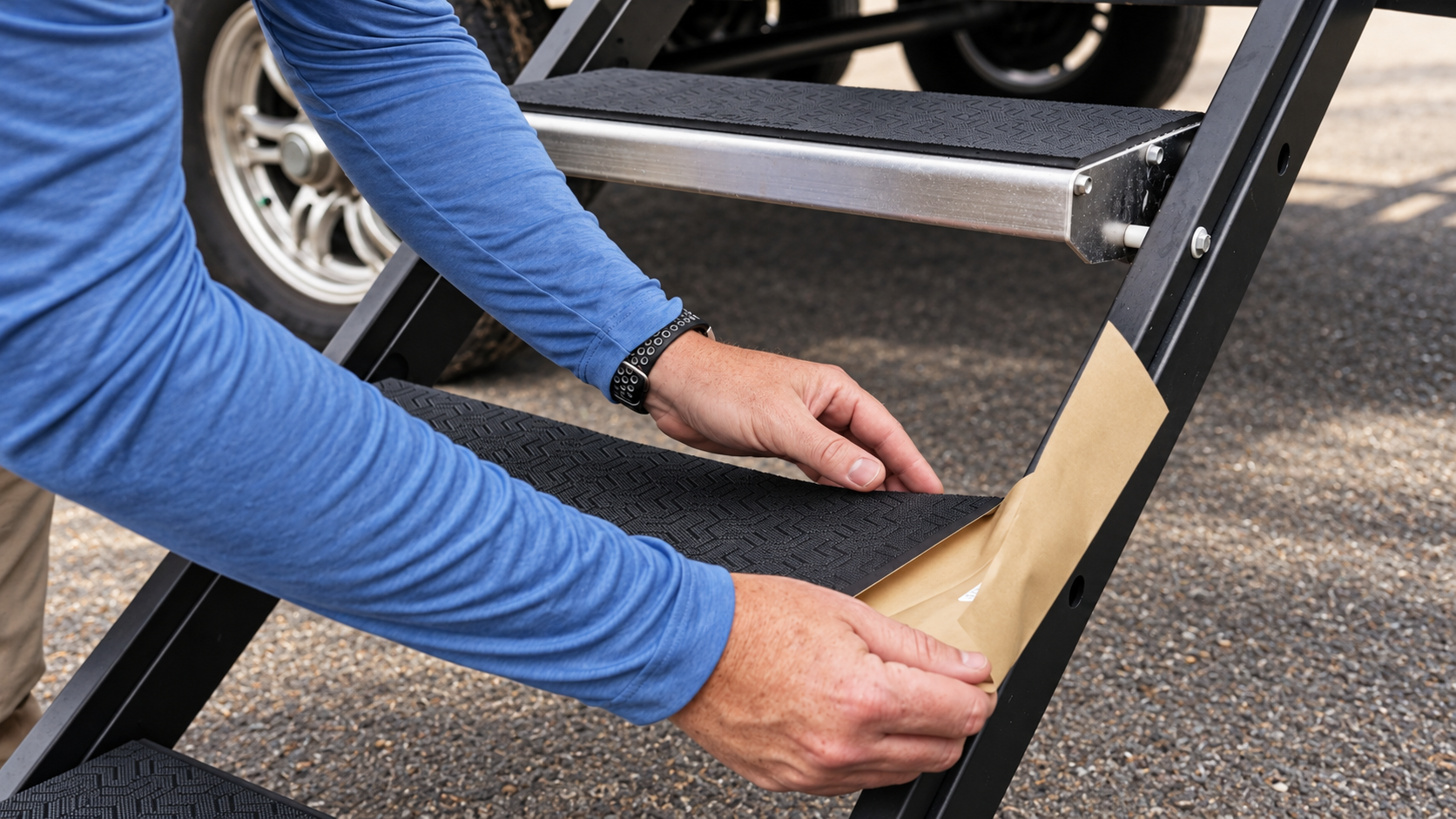
Grab a tape measure and treat each step as its own unique job (which it is, in a way). Note that pull-out and folding RV steps often taper, so the top step and the bottom step can differ by an inch or more. Be diligent, and take your time, as measuring all of them correctly saves you from ordering three of the wrong size later.
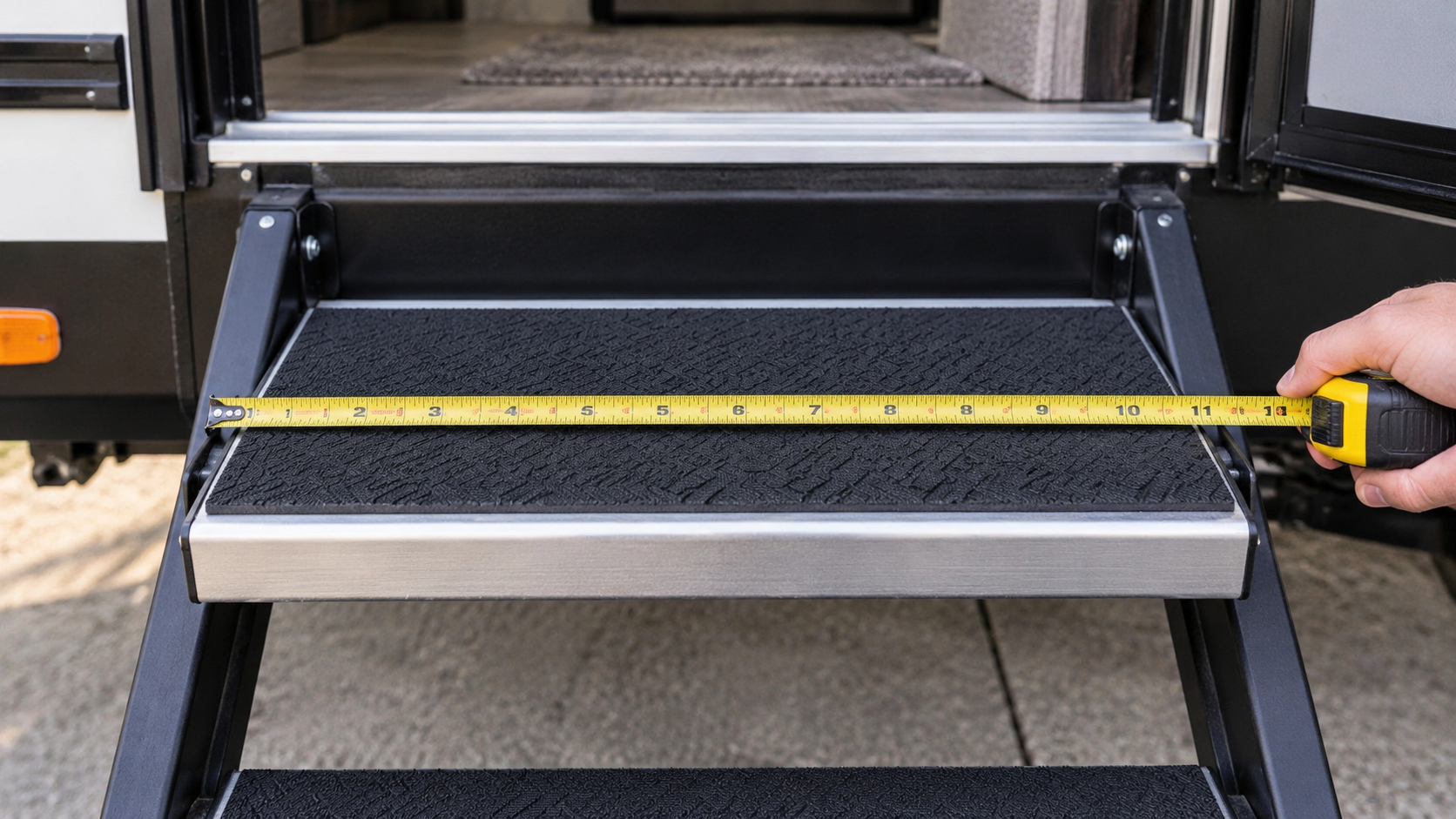
- Measure depth. This is the distance from the front edge of the tread to the back, the direction your foot points as you climb. Write it down for each step.
- Measure width. Run the tape from one side of the usable tread surface to the other, and note which number is which, because a 24" x 8.5" tread and an 8.5" x 24" step are very different animals.
- Check the front edge. Some steps are flat right out to a square lip, while others curve or round over at the front, and that shape decides whether you want a flat or a curved tread.
- Work around obstructions. If your step has raised ribs, drain holes or a grab bar bracket in the middle of the surface, measure the clear area around them so the cover sits flat.
|
ℹ️Need more information about fitting your new covers? The RV step covers installation guide covers surface prep and fitting, so measuring is really all you need to settle before you choose a size. |
Standard Sizes and Which Steps They Fit
SC Wake cuts twelve stock sizes of SeaDek RV step tread, eleven flat and one curved. The table below lists each one with the sort of step it tends to suit. Again, the process is simple - just match your measured numbers to the closest size, and remember that a cover a touch smaller than the step looks cleaner and wears better than one that hangs over the edge.
| Tread size | Shape | Typically suits |
|---|---|---|
| 17" x 7.5" | Flat | Narrow single or double entry steps on smaller campers |
| 17" x 10" | Flat | Narrow steps with a deeper tread |
| 19" x 7.5" | Flat | Standard-width folding steps |
| 19.5" x 7.25" | Flat | Standard folding steps with a shallower tread |
| 19.5" x 10.25" | Flat | Standard-width steps with a deep platform |
| 23" x 7.5" | Flat | Wider pull-out steps, shallow tread |
| 23" x 12" | Flat | Wide steps with a deep tread |
| 24" x 8.5" | Flat | Wide entry steps on larger trailers and fifth wheels |
| 24" x 13" | Flat | Wide, deep platform steps |
| 25.5" x 9" | Curved | Steps with a rounded or radiused front edge |
| 27.5" x 8" | Flat | Extra-wide motorhome steps |
| 27.5" x 16" | Flat | Oversized landing platforms and top steps |
If your measurements land neatly on one of these, you are in good shape to order, but if they are halfway between two sizes (or your step is wider or deeper than anything here) you might want to jump ahead to the custom quote section rather than forcing a poor fit.
Flat vs. Curved Treads
The choice between flat and curved is less about looks and more about what the front edge of your step actually does. Most RV steps are flat across the top with a squared-off front, and a flat tread drops straight onto them. That covers the large majority of rigs on the road.
Curved steps are the exception to the rule. Some manufacturers round the front lip of the step so there is a gentle radius where your foot rolls off, and a flat tread fitted to that kind of step will either lift at the front or crease as it tries to follow the curve.
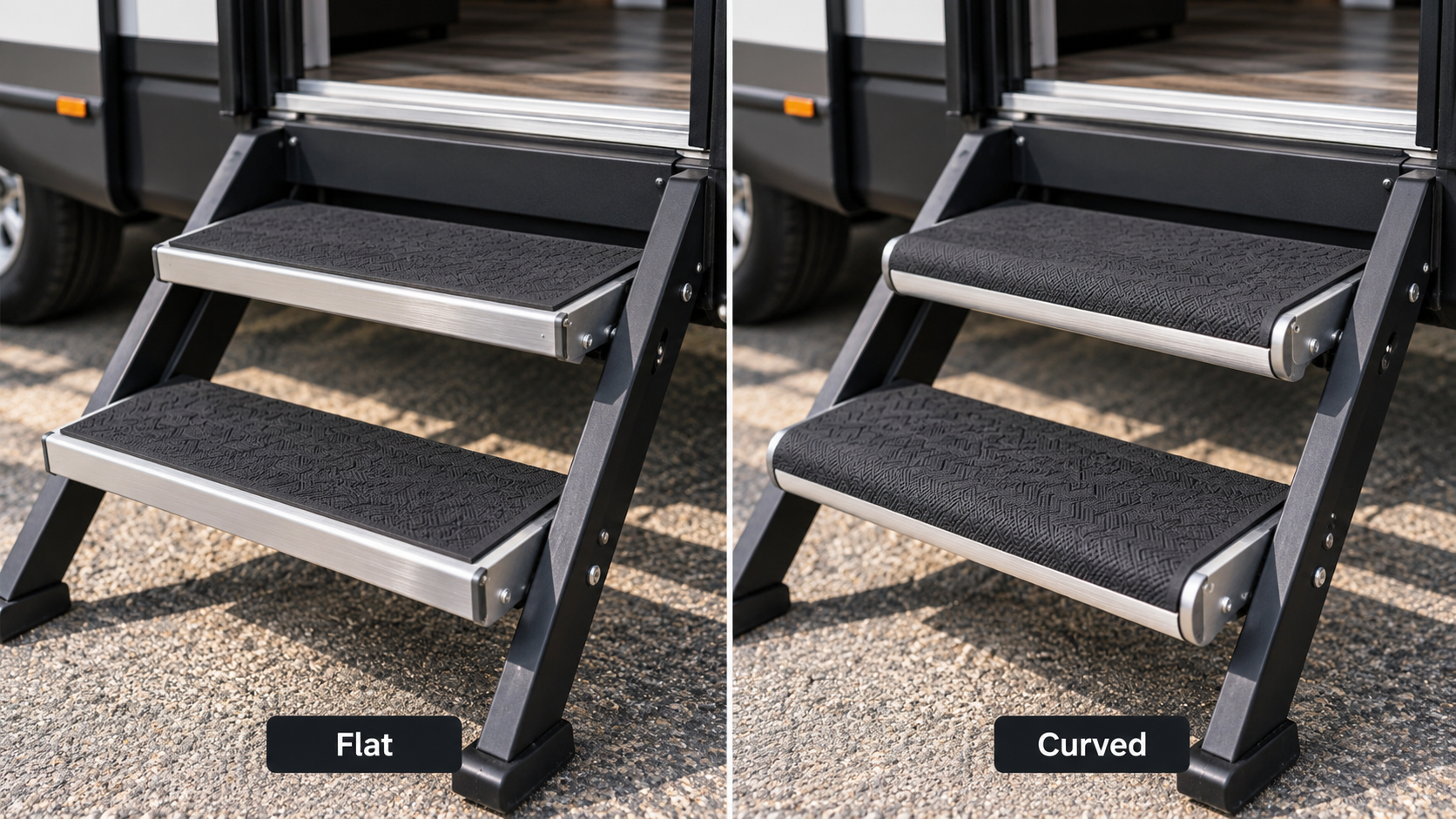
But in that regard, we’ve got you suitably covered. The 25.5" x 9" curved tread RV steps are cut specifically to wrap that rounded front edge and lie flat the whole way across.
Either way, the quick, foolproof test is to set a ruler or a straight edge along the top of your step from back to front. If it touches the whole way, you want flat RV step covers. If the front dips away from the ruler, you have a curved step and the curved tread is the one for you.
Thickness, Grip and Weather
SC Wake RV step covers are available in different thicknesses of the highly unique, proprietary SeaDek foam. The differences are revealed most evidently in the conditions RV owners actually deal with on a day to day basis. In other words, you need to select the right thickness, depending on your circumstances.
Thicker for comfort, thinner for a shallow step
Thicker foam gives you more cushioning underfoot and a little more insulation from the metal step below, which you notice more on a frosty morning when a bare step is cold enough to feel through your socks. Thinner foam is lower, and is barely noticeable under the sole, which some people prefer on a shallow step where every millimeter of height counts.
Grip comes from the texture
Grip is built into the surface texture rather than the thickness. The embossed and tetrapod patterns are designed to shed water and hold the sole of a boot, so they keep their bite when the step is wet from rain or slick with early frost. That traction is (for most people at least) the main reason to cover a step in the first place, and it is where molded plastic and bare aluminum often let you down.
Built for the weather
Weather is where SeaDek foam comes into its own, especially when compared with carpet-style step rugs. It does not soak up water, so it will not sit damp and grow mildew the way a fabric cover does, and it shrugs off UV rather than fading and going brittle in a season of sun.
Just rinse it with a hose when it gets dirty and it comes back looking close to new. For a step that lives outdoors in every kind of weather, a closed-cell foam tread is simply built for the job in a way a textile never will be.
When to Request a Custom Quote
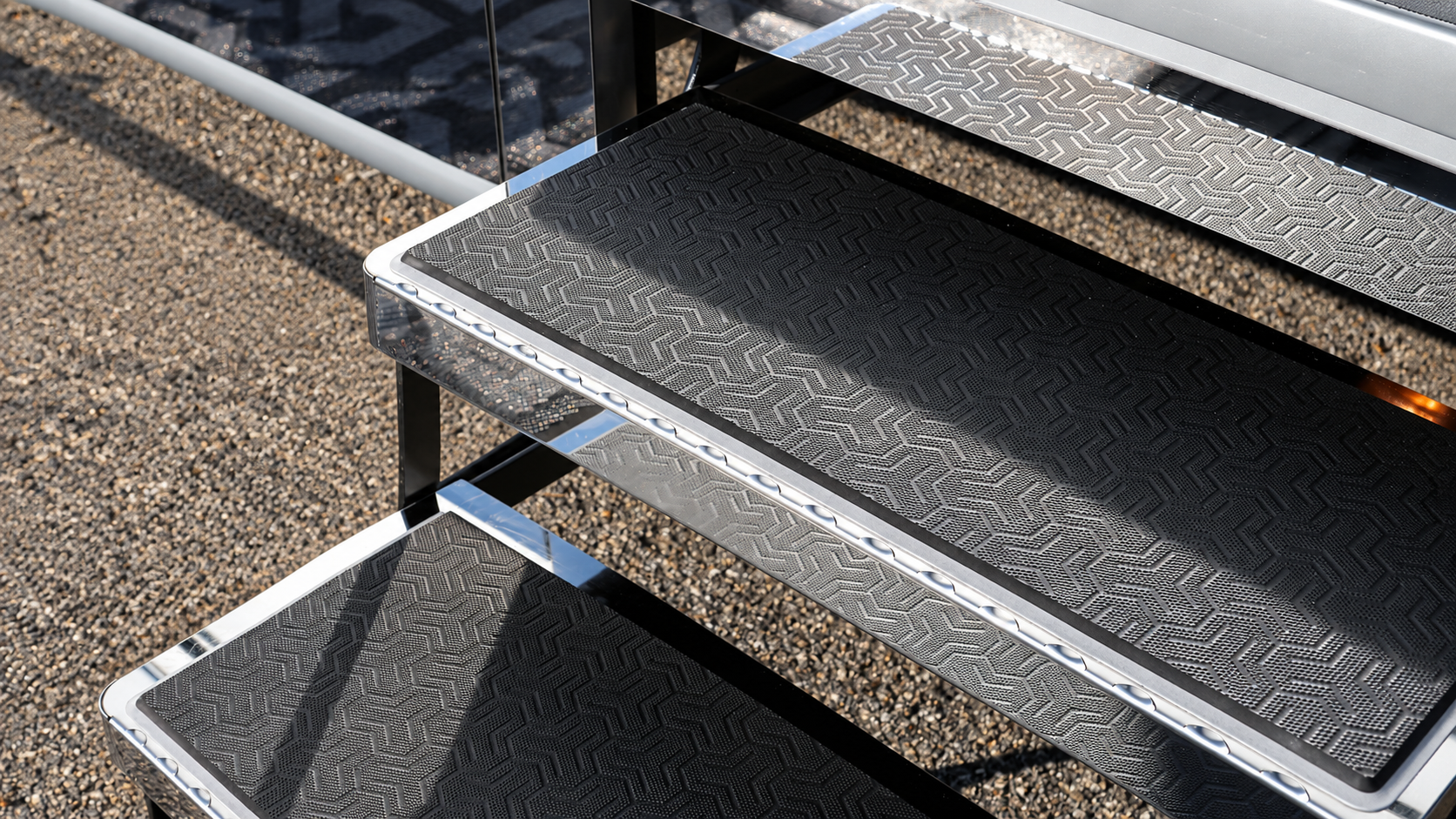
Stock sizes cover the common cases, but RV steps are not all built to a uniform, ‘tidy’ standard. If your measurements fall between two listed sizes, if the step is wider or deeper than the 27.5" x 16" at the top of the range, or if the shape is unusual, a custom-cut tread gets you a proper fit instead of a compromise.
Custom work also handles steps with awkward features: cut-outs for a folding mechanism, holes for a grab bar, a notched corner, or a surface that is neither cleanly flat nor cleanly curved.
Interested in upgrading this commonly overlooked but essential part of your rig? Request a quote by sending your measurements, along with a photo (or two) of the steps, and a note about anything odd, and we will send a size and a price back for your RV step covers.
Bottom Line
Good RV step covers won't cost you a fortune, but pay dividends over time. Apart from looking great and truly enhancing the entrance to your rig, you reap untold benefits by securing a safer grip on entrance.
They are also really simple to purchase, and install. Just measure the depth and width of each step, decide flat or curved from the front edge, and match it to the nearest size in the range.
The reward is a tread that grips in the wet, sits flush, and outlasts seasons of sun and frost. Odd-sized steps get the same treatment through a custom quote, cut to your exact dimensions. Measure today, and give your steps the grip they have been missing.
Browse the SC Wake Range of SeaDek RV Step Covers
About the Author: Erica Fisk is part of the SC Wake team, a SeaDek Certified Fabricator and Installer. SC Wake handles everything from templating and CAD design to CNC cutting and installation, helping boat owners across the country trade tired carpet for flooring that's built for the water.
FAQ
How do I measure my RV steps for covers?
Measure the depth of each tread from front to back and the width from side to side, using a tape measure, and do every step separately since they often differ. Note any ribs, holes or brackets on the surface and whether the front edge is squared off or rounded.
What size RV step cover do I need?
Match your measured depth and width to the closest size in the SC Wake range, and choose a cover slightly smaller than the step rather than one that overhangs the edge. If you sit between two sizes, a custom cut will fit better than either stock option.
Should I choose a flat or curved tread?
Choose flat for steps with a squared-off front edge, which is most RVs, and curved for steps with a rounded or radiused front lip. Lay a straight edge along the top of the step from back to front: if the front dips away from it, you need the curved tread.
Will SeaDek step covers fit my RV?
They fit if your step measurements match one of the stock sizes, so always measure before you order rather than going by your RV's make or model. For steps that fall outside the standard sizes, a custom quote covers the gap.
Do thicker treads grip better in rain and frost?
Grip comes from the surface texture rather than the thickness, so a thin and a thick tread with the same pattern hold a wet boot about equally well. Thickness mainly changes cushioning and how much you feel the cold or heat of the step underneath.