
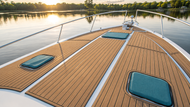
SeaDek Patterns Explained: Styles, Layouts, and Design Tips
posted by Erica Fisk on Sep 30th 2026
The first time you look at everything SeaDek offers, and by everything we mean the entire extensive range of colors, styles, and textures, it's probably quite a lot to take in. So much so, in fact, that you would be forgiven for feeling somewhat overwhelmed by it all.
To start with, there are 35+ colors, several textures, four tiers of routing patterns, and a deep library of laser-cut designs to rifle through. If that isn't enough to send your head spinning in a whirl of creative possibilities, you can also throw thickness options and multi-layer color builds into the mix.
It's Simpler Than It Looks (Honestly)
But while it may seem like a minefield, the whole process of choosing your perfect combination is quite easy to grasp, actually.
The idea of this short guide is to help you understand how everything fits together for your boat, so you can know the difference between a texture and a routing pattern, what a two-color or three-color kit means, and which combinations tend to work for which kinds of boats.
Once you see how the SeaDek patterns are organized, the whole thing becomes effortless, and almost quite fun. But first, let's go over a few pointers on how the whole system is stitched together.
How the SeaDek Design System Works
Every SeaDek design comes from four overlapping choices, with the whole design system being built around them. This is where we should start, because if you get these straight, the entire catalog becomes quite easy to navigate.
- Color: 35+ named SeaDek colors, from soft neutrals to punchy brights. Multi-layer designs stack two or three colors.
- Thickness: 5mm single-color up through 23mm. Two-color kits start at 6mm, three-color kits are 9mm, and dual-density 20mm pairs a soft base with a firm top for that anti-fatigue feel.
- Texture: the surface finish underfoot. The two main families are the Comfort Series (Brushed or Embossed) and the HD Series (Tetrapod).
- Routing pattern or laser-cut design: the visual cut into the foam. This is what most people mean when they say pattern.
Pretty simple, really. Color, thickness, texture, and pattern. They are your four main elements. Not every combination is available, though. Some SeaDek colors are limited to certain thicknesses, and a few textures only come in select colors.
But don't worry too much about that, as SC Wake's design team can help you figure out what's actually possible before anything gets cut.
Textures: Comfort Series vs HD Series
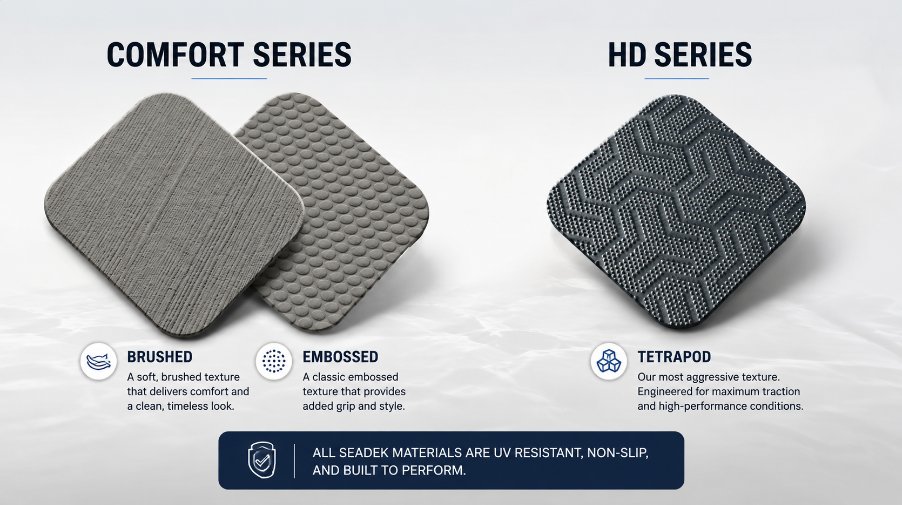
The SeaDek textures are the foundation of how SeaDek feels, which is separate from how it looks. The textures are broken down as follows:
Comfort Series
The Comfort Series has two options. Brushed is soft and cushioned underfoot with strong traction even when wet, which is why most people pick it for helm pads, swim platforms, and DIY installs. Embossed has a more pronounced grip that improves wet and dry traction and resists scratches, so it lands on coolers, coaming boards, and busier areas.
HD Series
The HD Series brings the new Tetrapod texture, which gets its own section below. Laser-etched textures are also available in select colors if you want a more decorative surface. The short version: reach for Comfort Series on most marine flooring, and HD Series when the deck takes a beating.
The New HD Tetrapod Texture
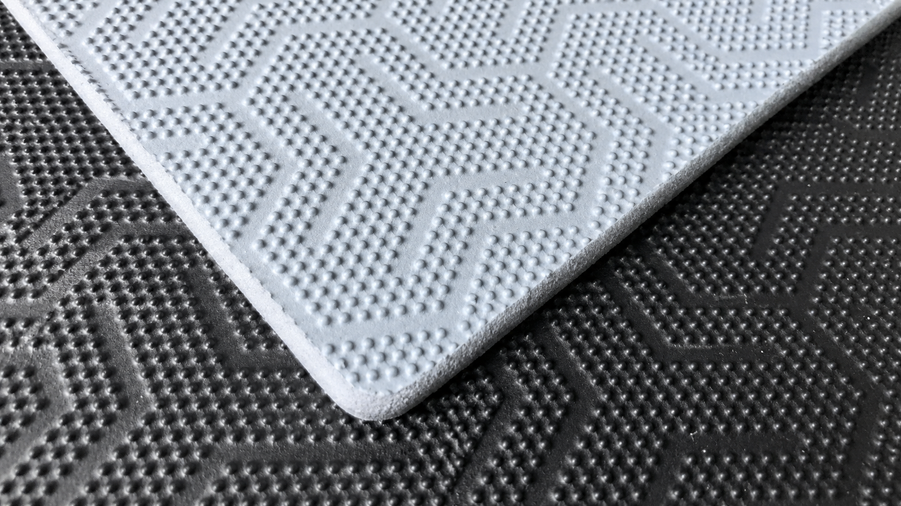
HD Tetrapod is SeaDek's newest texture, engineered rugged for demanding environments. It's a high-traction non-skid surface built for heavy foot traffic, commercial use, and harsh conditions where Comfort Series textures would wear out faster. It comes in 5mm Black or Storm Gray as the top color, with an optional 3mm bottom layer bringing the build to 8mm so a contrasting under-color peeks through the routing.
What makes the SeaDek Tetrapod quite so special is a tougher, more aggressive grip and higher resistance to scratches, scuffs, and abrasion. It's made for decks where dropped tackle, gear, boots, and weather all gang up on the surface.
Best applications include SxS, ATV, and UTV floor mats, RV steps, truck step pads, dock and entry mats, hard-use boarding steps, and commercial or charter vessels.
|
ℹ️ Quick Tip: HD Tetrapod is built for the rough stuff. If your boat sees heavy gear, wet boots, kids in cleats, or fishing tournaments where the deck takes a beating, this is the texture worth asking about. |
Routing Patterns: From Basic to Elite
Routing patterns are the visual designs CNC-cut into the foam, and SeaDek organizes them into four tiers.
Basic keeps things understated. Beveled Edge is a clean angled cut around the perimeter with no internal pattern, while Border Trim adds a routed border, often paired with a contrasting under-color for definition.
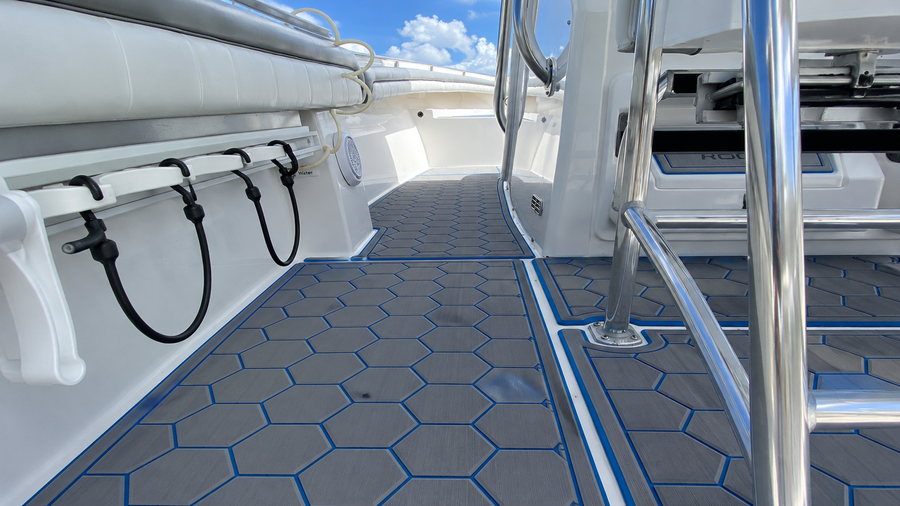
Standard is where most owners land, with options like Sunburst, Hexagons, Diamond, Bike Chain, Waves, Denver, Vidalia, Old Hardwood, Roswell, Fractals, and Barn Quilt, plus the faux teak family covered below.
Premium steps up the visual complexity with designs such as Herringbone, Fish Scales, Charlie Brown, The Markwell, SC G Star, Armor, Kaleidoscope, Independent, Mufassa, and Whistling Nerf. These suit owners who want something more distinctive.
Elite is the top shelf: MC Tile, Circuit Board, Wavesurfer, Wicker, Cubes, Tetris, Circle Pattern, Arrowhead, Cat Eye Diamond, Jellyfish, Striped Diamond, and Bandana Design. Pick one of these when you want the deck to be the focal point. Custom routing is also available through SC Wake's quote portal if you have your own idea.
Faux Teak: A Pattern Family of Its Own
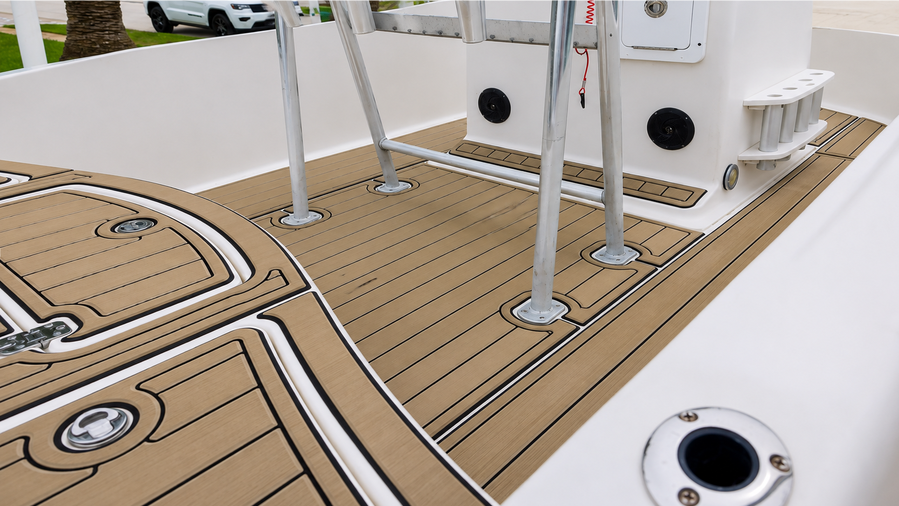
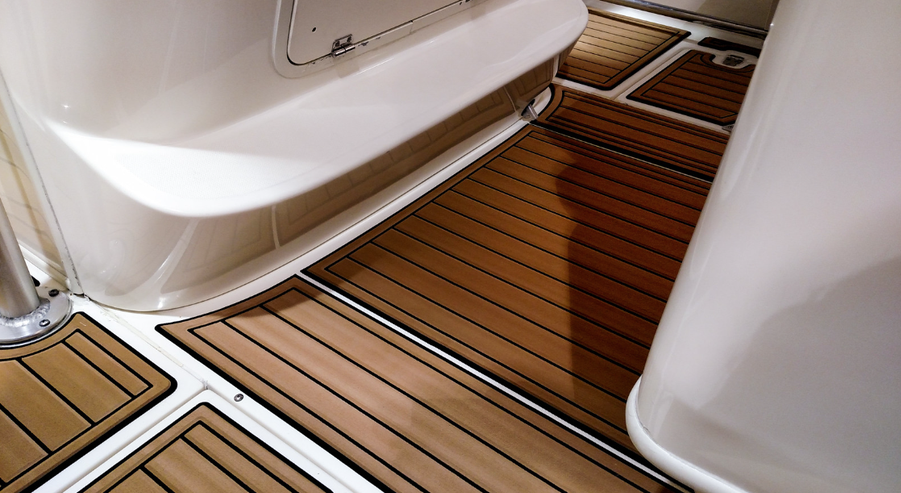
Faux teak earns its own section in this guide because it's one of the most-requested SeaDek styles, with routing patterns that mimic planked teak boards, seam lines and all, in three standard plank widths.
The 2-Inch version gives a tighter, detailed look that suits smaller boats, the 3-Inch is the balanced all-rounder most owners choose, and the 4-Inch offers wider planks for a more open, modern feel. Angled Teak runs those planks on a diagonal for a sportier take.
Faux teak is almost always a two-color or three-color kit, with the routing exposing a darker under-color to imitate the caulked seams of a real teak deck. Favorite pairings include Mocha over Beach Sand, Mocha over Black, Storm Gray over Bimini Blue over Black, and Terra over Chocolate.
|
ℹ️ Quick Tip: Faux teak SeaDek is one of the most direct alternatives to real teak decking. The visual is convincing from a few feet away, but the feel underfoot is pure foam comfort. |
Laser-Cut Designs and Wood Grain Etching
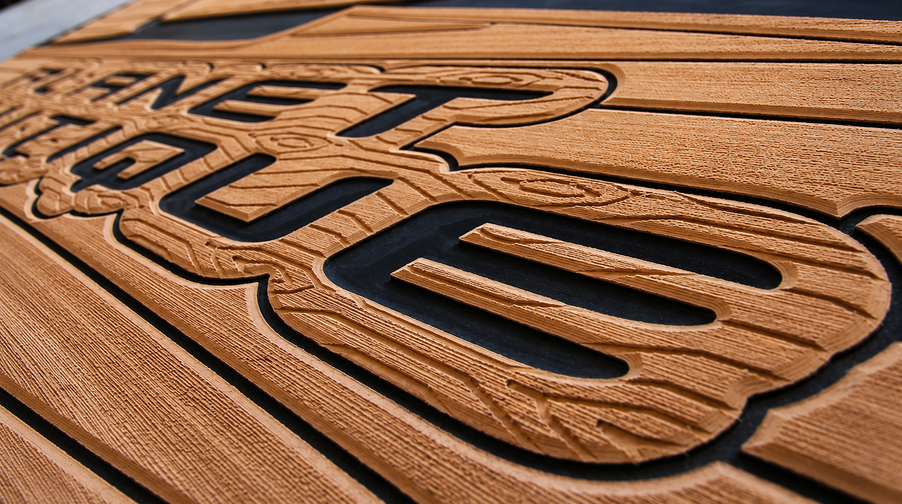
Laser-cut designs are a separate category from routing patterns. Instead of being cut through the foam, these intricate patterns are burned into the surface. The catalog runs deep, with herringbone, honeycomb, palm, ripple, scaffold, Spanish tile, stone, travertine, weave variants, fern, fish scale, fault line, geo, hatchet, pulse, puzzle, and plenty more.
Laser Etch Wood Grain is a specific application that adds a natural wood-grain look to the surface, and it pairs especially well with faux teak builds. Laser designs shine when you want visual interest in specific zones, like a swim platform or helm area, without committing to a full routing pattern across the whole deck.
Colors and Color Combinations
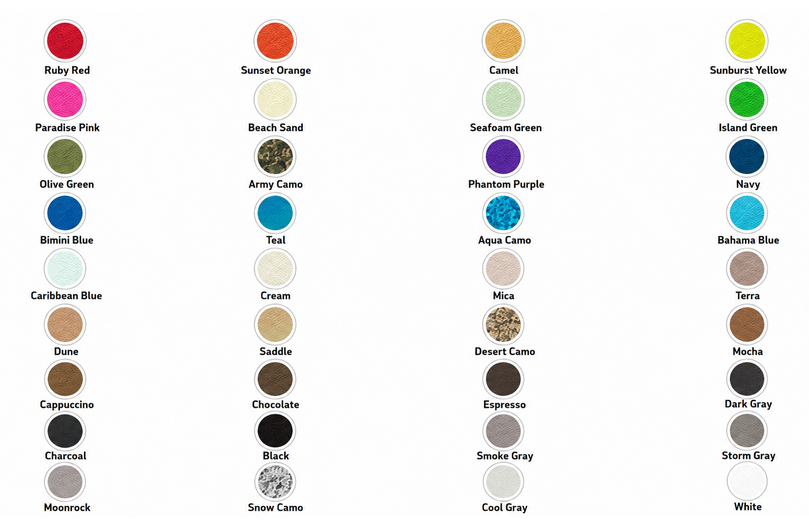
Color is where personalization really takes off, and the range of SeaDek colors runs from quiet neutrals to high-saturation brights. The simplest builds are single-color 5mm kits, which are budget-friendly, reliable, and clean.
Two-color kits (6mm, 8mm, 13mm, 20mm, or 23mm) open up real possibilities, since the under-color shows through routing lines and beveled edges to add depth. Three-color kits (9mm) go further still, making room for borders, logos, and layered designs.
A few tested combinations make good starting points: Storm Gray over Black for a modern low-key look, Mocha over Beach Sand for warm faux-teak vibes, Dark Gray over Bimini Blue for a sporty marine feel, Terra over Chocolate for something rich and classic, and Storm Gray over Ruby Red when you want bold contrast.
Keep in mind that screen colors never reproduce perfectly, so a SeaDek sample kit is the most reliable way to confirm your choice.
Layout Tips: Designing for Different Parts of the Boat
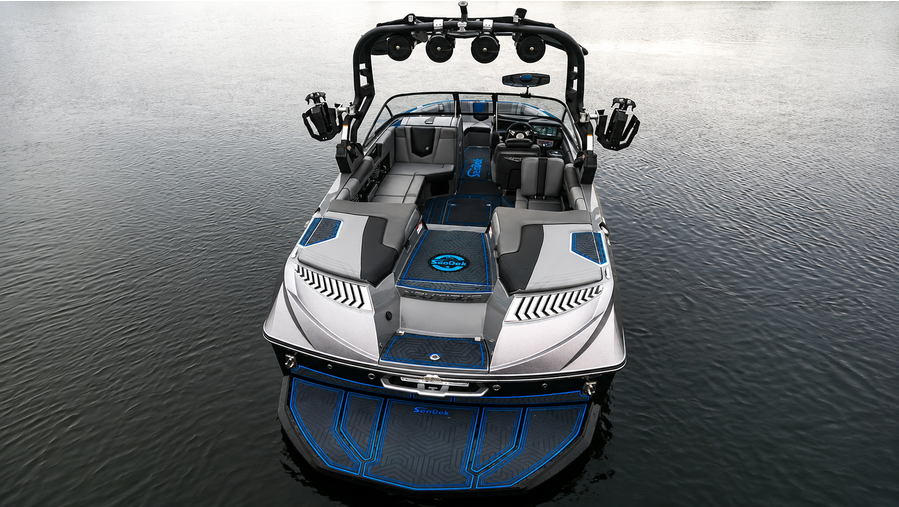
Not every area of the boat needs the same texture, pattern, or color. The smartest layouts mix and match by zone, matching the surface to how each spot actually gets used. Here's a quick reference for where each option tends to work best:
|
Boat Zone |
Recommended Texture |
Why It Works |
|
Helm and cockpit floors |
Brushed Comfort Series |
Long-day comfort, often with faux teak or a clean routing pattern on top for looks |
|
Swim platforms and bow areas |
Brushed Comfort Series |
Barefoot comfort, and a natural home for laser-cut designs or custom logos |
|
Coaming boards and gunnels |
Embossed |
Grip and scuff resistance, usually in a color that contrasts the main deck |
|
Coolers and step pads |
Embossed or HD Tetrapod |
Durability in spots that take repeated abuse |
|
Helm bolsters and standing zones |
Dual Density 20mm |
Anti-fatigue cushioning you'll notice after a few hours |
|
High-traffic boarding steps |
HD Series Tetrapod |
Aggressive grip and long-term durability |
Matching Patterns to Your Boat Type
The right pattern depends as much on what your boat does as on what you like. A tournament fishing rig and a family pontoon call for different looks and different textures, so here's how the choices tend to shake out by boat category:
Center consoles and offshore rigs: Functional layouts win. Diamond, hexagon, or faux teak routing in neutral two-color combos, Embossed in the working areas, Brushed where bare feet go, and custom logos for tournament boats.
Bay and flats boats: Lighter colors keep the deck cool. Faux teak in 2- or 3-inch widths with Brushed throughout is the popular pick.
Ski and wake boats: Sportier patterns like Sunburst, Diamond, or Waves match the active look, and bolder color combos work well.
Pontoons: Wider patterns such as 4-Inch Teak or Old Hardwood suit the open deck, usually in lighter neutrals.
Sport boats and runabouts: Modern routing like Hexagons, Striped Diamond, or Cat Eye Diamond fits the contemporary lines.
Cruisers and yachts: Faux teak in 3- or 4-inch widths, often with Wood Grain etching, nails the traditional yacht aesthetic.
Five Pro Design Tips Before You Order
✔️ Order a sample kit first. Screen colors mislead, and physical samples make the final choice obvious.
✔️ Look at finished installs. Browsing real boats in SC Wake's gallery often surfaces combinations you wouldn't have thought of.
✔️ Don't overdesign. Pick one statement element and let the rest support it, because multiple statement pieces just compete with each other.
✔️ Think about contrast. The under-color is what makes a routing pattern visible. Low contrast reads subtle, high contrast reads bold.
✔️ Match the boat's purpose, not just its looks. A premium pattern photographs beautifully but might be wrong for a hard-working fishing boat, where a clean Standard pattern often serves better.
Bringing It All Together
The SeaDek design system is deep, but it's logical once you see the structure. Textures, colors, thicknesses, routing patterns, and laser designs all stack together to create the final look.
For most owners the easiest path is to start with a clear sense of how the boat gets used, narrow the choices from there, then order a SeaDek sample kit to confirm colors and textures in person.
And you don't have to figure it all out solo. SC Wake's design team handles everything, so you describe what you want, they work out the combinations that are technically possible, and they send back design proofs before anything gets cut.
Ready to see what your deck could look like? Browse the full design options, request a sample kit, or get a custom quote to get started.