

SeaDek for Pontoon Boats
posted by Erica Fisk on Aug 31st 2026
Pontoon boats have long gotten the short end of the stick when it comes to flooring options.
For decades, builders stuck with carpet as the default - and not the good stuff, either. It soaks up water in just one season, then starts reeking to high heaven after two or three.
Vinyl seemed like a logical solution since it doesn't hold moisture. Problem is, it gets slick as ice when wet, which is far from ideal when you’re bobbing about on the high seas. As for bare aluminum, it's uncomfortable, slippery, and turns into a scorching, torturous hotplate the minute summer hits.
There Had to Be a Better Option
Carpet that rots, vinyl that slips, or aluminum that burns - not exactly stellar options, you probably agree - but pontoon owners have been choosing between these rather lacklustre options for many years, while the industry dragged its feet on anything better. That is, until SeaDek showed up.
In this quick post, we have broken down why SeaDek beats them all as a pontoon flooring option. But first, a primer for anyone new to it: what is SeaDek, exactly, and why would you need it for your pontoon?
What Is SeaDek?
SeaDek is a specialist marine flooring made from closed-cell PE/EVA foam. It is UV-resistant, completely non-absorbent, and backed with marine-grade adhesive for peel-and-stick DIY SeaDek installation.
You will find it all over performance boats, center consoles, and yachts these days, swapping out gelcoat nonskid and teak for a surface that grabs when wet, softens your steps, and just needs a quick hose-down with mild soap to stay fresh.
Of course, we are a bit on the biased side here, but in all honesty, SeaDek for pontoon flooring is nothing short of remarkable.
Easy Fitting
It works especially well as pontoon boat flooring because pontoon decks tend to be large, flat, and uniform, which is the perfect scenario for an effortless cut-and-install. This unique, cleverly engineered material is installed in precision-cut sections and bonds directly to the deck, resulting in a finished look that appears factory-installed to many.
SeakDek for pontoon boats ships with a three-year warranty on materials and workmanship, whether the kit is pre-cut or custom fabricated.
SeaDek vs. Carpet, Vinyl, and Bare Aluminum
Traditionally, the debate among pontoon owners has been between carpet and vinyl, until SeaDek introduced a new option that addresses the weaknesses of both.
The comparison below shows how the materials compare in real-world use:
|
Factor |
SeaDek (EVA Foam) |
Snap-In Carpet |
Marine Vinyl |
Bare Aluminum |
|
Comfort & Cushioning |
Closed-cell foam absorbs shock and vibration. Available in 6mm to 23mm. |
Soft underfoot but compresses over time. No shock absorption. |
Hard. No cushioning. |
Hard, resonant, unforgiving. |
|
Wet Traction |
Reliable grip when completely soaked. The textured surface stays consistent. |
Gets slippery when saturated, which it will be. |
Notoriously slick when wet. |
Smooth aluminum and water are not friends. |
|
Water Absorption |
Zero. Non-absorbent by design. |
High. Takes days to dry fully. |
Low, but seams trap moisture. |
None, but pooling water creates slip hazards. |
|
Mold & Odor |
Completely resistant. |
Highly prone. Trapped moisture breeds mold and that smell. |
Resistant when maintained. Seams are vulnerable. |
Resistant, but standing water promotes corrosion. |
|
Heat in Direct Sun |
Moderate. Lighter colors stay cool. |
Generally cool - one of carpet's few genuine advantages. |
Gets very hot. |
Extreme. A genuine liability in summer. |
|
Cleaning |
Hose rinse and mild soap. |
Vacuum, scrub, deep clean. Stains set permanently. |
Wipes down easily. |
Low maintenance, but shows every scuff. |
|
Customization |
36 colors, 29+ routing patterns, custom logos, laser etching. |
A handful of colors and weaves. |
Several woven patterns and solids. |
None. |
|
Lifespan |
5–8+ years with basic care, longer if covered. |
10–20 years structurally, but the appearance degrades. |
5–10 years, depending on UV. |
Indefinite, but the surface offers nothing useful. |
SeaDek Textures
One big reason SeaDek has built such a die-hard fanbase across the boating world is the insane level of customization it offers.
It's a fully customizable flooring system - pick your textures, colors, thicknesses, and even design patterns to match your style and how you actually use your pontoon.
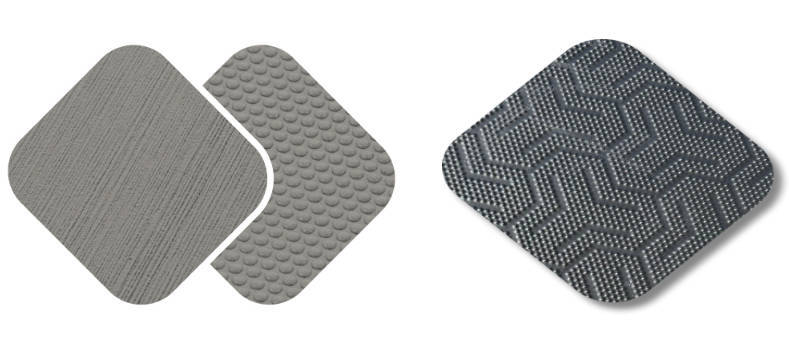
There are four texture options in total, each suited to different applications:
- Comfort Series - Brushed: A soft, barefoot-friendly surface with excellent wet traction. This is the texture most owners gravitate toward for helm pads, swim platforms, and general deck coverage. Generally comfortable enough to stand on all day, yet grippy enough to feel secure when the deck is drenched.
- Comfort Series - Embossed: A more pronounced grip pattern with better scratch resistance, designed for higher-traffic areas like walkways, cooler pads, and coaming boards. SC Wake uses Embossed as the standard texture on their Sea-Doo Switch kits.
- Laser Etched: Available in select colors, this option adds a subtle visual texture through laser processing. This is a more refined finish for owners who want something a little different.
- HD Series - Tetrapod: The heavy-duty option, built for commercial environments and harsh conditions. Available only in 5mm Black or Storm Gray with an optional 3mm bottom layer for 8mm total construction. It might be overkill for some recreational pontoons, but it is a great option for maximum durability.
SeaDek Colors
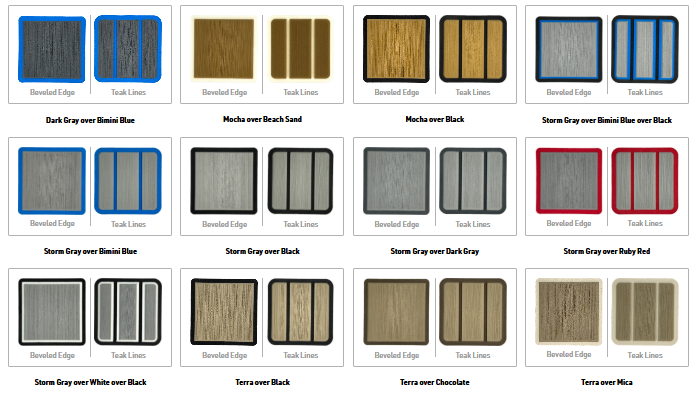
SeaDek's color palette runs to thirty-six options, with a range that is far broader than most pontoon owners might expect. There are cool coastal tones, rich earth shades, and a handful of options bold enough to turn heads at the marina.
|
Color Family |
Options |
|
Reds & Warm Tones |
Ruby Red, Sunset Orange, Paradise Pink, Sunburst Yellow, Camel |
|
Greens |
Seafoam Green, Island Green, Olive Green, Army Camo |
|
Blues & Purples |
Phantom Purple, Navy, Bimini Blue, Teal, Aqua Camo, Bahama Blue, Caribbean Blue |
|
Neutrals & Earth Tones |
Cream, Mica, Terra, Dune, Saddle, Desert Camo, Mocha, Cappuccino, Chocolate, Espresso, Beach Sand |
|
Grays, Blacks & Whites |
Dark Gray, Charcoal, Black, Smoke Gray, Storm Gray, Moonrock, Snow Camo, Cool Gray, White |
Two-tone combinations are standard on 6mm and thicker material, which is where the design possibilities really open up. The most popular pontoon combination by a wide margin is the faux teak look - Storm Gray over Black with teak line routing.
Other popular pairings include Mocha over Beach Sand, Dark Gray over Bimini Blue, and Storm Gray over Dark Gray.
|
There are thirty-nine SeaDek patterns and designs across four tiers, roughly fifty laser-cut designs, plus the option to submit custom artwork for logo and boat name engraving. |
Where SeaDek Works Best on a Pontoon
Big, flat, and uncomplicated, pontoon decks are gloriously simple. But that doesn't mean every inch needs the same treatment. Some areas earn their SeaDek faster than others, and knowing where to start helps owners get the most from their investment.
The Helm
Nobody buys a pontoon to stand in one spot for four hours, and this can happen, given that this is where captains plant themselves. On hard surfaces, fatigue creeps in quickly, with knees and lower backs aching.
A cushioned helm pad changes this equation entirely, and since someone inevitably clambers aboard still dripping from the lake, the wet traction proves its worth before the engine even starts.
Swim Platforms and Boarding Zones
Pontoon slip-ups happen right here, courtesy of wet feet from the water, hurried jumps off the boat, and slick factory floors. The physics practically guarantee it. SeaDek's grip holds steady whether dry, damp, or soaked, which is preferable to ending up in the ER with a broken wrist, you will agree.
Steps and Transitions
Easy to overlook, these small sections between deck levels see constant traffic. SeaDek Step Pads prevent the kind of stumble that turns a relaxed afternoon into something potentially quite painful. They look great, too.
Bow Lounging Areas
For pontoons with forward seating or sunpad setups, the bow deck doubles as a barefoot relaxation zone. Comfort trumps traction here, as nobody wants to sprawl out on scorching aluminum or wrestle with damp carpet. SeaDek's cushioning makes extended lounging genuinely quite pleasant, which is rather the point of owning a pontoon in the first place.
Full Deck Coverage
Increasingly, owners skip the piecemeal approach entirely and cover everything. The visual reward is immediate: a complete SeaDek installation really can make a decade-old pontoon look like it arrived from the factory last month.
Pre-Cut Kits vs. Full Custom Fabrication
Should you go with pre-cut kits engineered for specific pontoon models, or fully custom SeaDek Pontoon Flooring shaped to your exact deck? Let's take a look at both SeaDek pontoon boat flooring options:
Pre-Cut Kits
SC Wake stocks pre-cut kits in accordance with factory specifications. They arrive ready to install, with no templating or measuring. The benefit of pre-cut is faster arrival and installation, predictable pricing, and, for owners whose boats match the kit specs without modification, a considerably simpler process.
Custom Fabrication
Then there's the bespoke option, which tends to suit modified pontoons, older models without kit availability, or owners who simply refuse to have the same flooring as the boat three slips down.
The process involves templating the deck (SC Wake supplies materials and walks owners through it), submitting measurements, and receiving precision-cut pieces built for that specific hull. It takes longer and costs a little more, but the result is a beautiful fit as though it grew there organically.
|
Approach |
Best For |
Turnaround |
Cost |
|
Pre-Cut Kit |
Popular models, stock configurations |
Faster |
Lower |
|
Custom Fabrication |
Modified boats, older models, owners wanting something unique |
4–6 weeks typical |
Higher |
Either way, SeaDek pontoon floor covering ships with the same three-year warranty. Both use identical materials - the decision comes down to what the boat needs and what the owner wants.
The Sea-Doo Switch: A Pontoon That Needed Better Flooring
Sea-Doo did something interesting with the Switch. They took the pontoon concept, strapped jet propulsion to it, and created a vessel that appeals to owners who find traditional pontoons a bit too mundane, or even a little sedate. It's nimble, surprisingly quick, and has developed a devoted following since launch.
The problem is that the flooring didn't get anywhere near the same level of attention.
Factory Switch decks arrive with a rubberized surface that performs adequately until summer properly arrives, at which point it absorbs heat quickly and offers poor traction.
For a boat engineered to handle more aggressive maneuvering, the floor feels oddly substandard. Our Sea Doo Switch Floor Mats have been created to solve this problem directly, with the following options available:
- 13' Sport Model: Compact coverage for the entry-level Switch
- 16' Sport Model: Mid-size kit with full deck and platform options
- 18' Cruise & Sport Models: Extended coverage matching the larger footprint
- 21' Cruise Model: Full-size kit for the flagship platform
All Switch kits use the Embossed texture as standard, offering the same reliable grip, improved scratch resistance, and a surface that actually matches the boat's performance ambitions. Coverage spans the main deck, swim platform, and helm areas, with the full SeaDek color palette available.
Installation follows the same peel-and-stick process, and the pre-cut geometry accounts for the Switch's unconventional deck layout.
Keeping SeaDek Looking Its Best
One of the many advantages of SeaDek pontoon boat flooring is its low maintenance requirements. Unlike carpet, which traps everything from lake water to spilled drinks, SeaDek’s closed-cell EVA foam does not absorb moisture or stains.
A quick rinse with fresh water removes loose dirt, sand, and sunscreen residue that tends to accumulate during a busy day on the lake. For stubborn spills, a bucket of warm water with mild soap and a soft brush is usually enough to restore the surface to its original appearance.
Always avoid harsh chemicals, pressure washers, or stiff wire brushes, as these can damage the foam texture or weaken the adhesive backing over time. In practice, however, maintenance tends to be mercifully simple - almost effortless, really. In most cases, if the deck looks dirty, a hose and five minutes of light scrubbing will put things right again.
|
Keep your SeaDek looking new with SC Wake Boat Juice, designed for marine flooring and surfaces like SeaDek. A quick spray followed by a light wipe helps remove sunscreen residue, lake grime, and algae film, and light stains from drinks or food. |
SeaDek Ends Pontoon Flooring Nightmares!
Pontoon owners have put up with substandard flooring for decades, with carpet that rots, vinyl that slips, and aluminum that could double as a frying pan at certain times of the year. The industry offered these options because better alternatives didn't exist, or at least didn't exist at prices that made sense.
SeaDek pontoon boat flooring changed everything, while adding comfort, customization, and a lifespan that other flooring options can't compete with. SeaDek doesn't absorb water or support mold growth, and it certainly doesn't become sketchy the moment someone steps aboard with wet feet.
But Is SeaDek Worth the Upgrade?
Is it more expensive than replacing worn carpet with more carpet? Yes, slightly. Either way, boat owners who make the switch (pun somewhat intended) tend not to regret it. Ultimately, the maintenance burden drops, the deck looks dramatically better, and the boat becomes genuinely more pleasant to use.
Interested in exploring more? Request a quote, and our team will advise on kit availability, custom fabrication timelines, and the best approach for your specific boats.